Magenta Color Meaning, Codes, Symbolism, Psychology + More
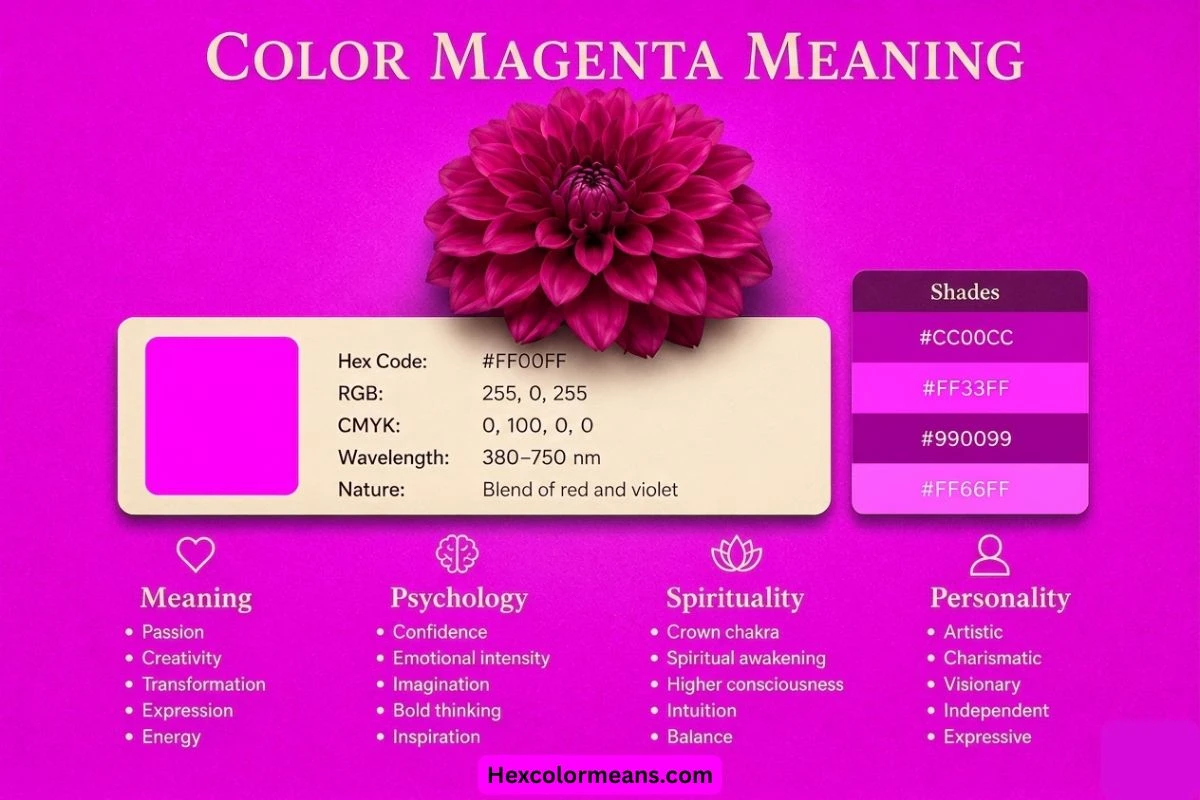
Magenta sits between red and pink on the color spectrum, yet it fully belongs to neither.
That positioning gives magenta a character unlike any other color. It pulses with energy but carries emotional warmth. It commands attention without the aggression of pure red. Likewise, it feels romantic yet assertive.
Picture bold fashion statements and neon city signs. Think of tropical flowers bursting open in sunlight. Consider the fuchsia tones in a sunset just before darkness falls.
All of these share a common quality. They stop you. They pull your gaze immediately. Magenta never blends quietly into the background.
In color psychology, magenta is recognized as the color of emotional balance, universal love, and transformation. It does not whisper. But it also does not overwhelm.
Magenta asks you to feel things fully. It pushes you toward change. And it carries the rare ability to be both grounding and electrifying at the same time.
Key Takeaways
- Magenta represents universal love, emotional harmony, compassion, and bold transformation.
- Psychologically, magenta encourages emotional release, positive change, and creative confidence.
- Spiritually, magenta links to the heart chakra’s higher octave and unconditional love.
- For brands, magenta communicates innovation, energy, and modern boldness.
- Across cultures, magenta symbolizes passion, femininity in some traditions, and spiritual evolution in others.
What Is the Color Magenta?
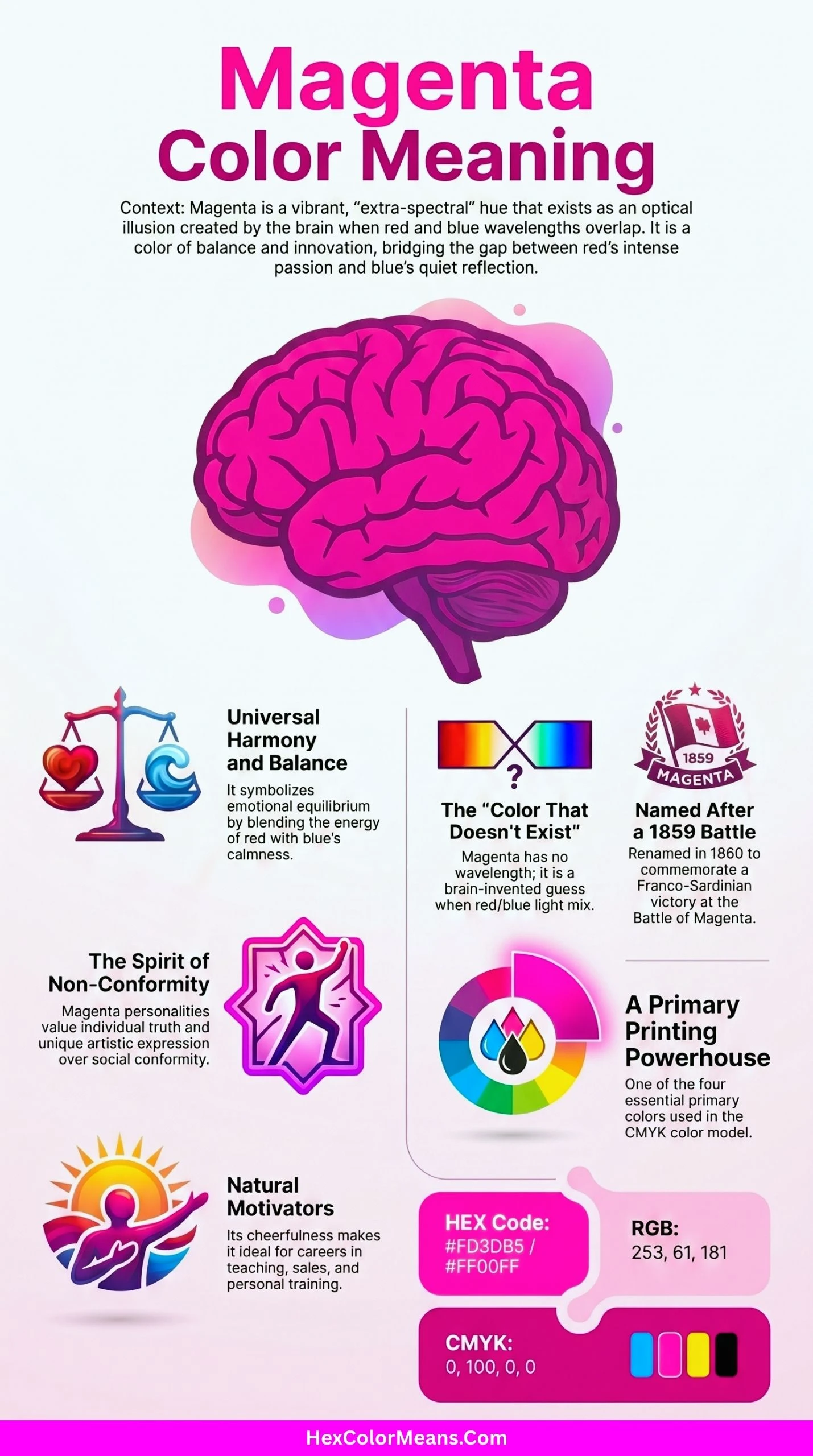
Magenta is a non-spectral color. This is one of the most fascinating facts about it. Unlike red, green, or blue, magenta does not appear on its own in the visible light spectrum. Your brain actually creates it as a bridge between red and violet wavelengths.
In terms of pigment, you create magenta by blending red and blue in roughly equal parts, with red slightly dominant. In light, magenta is the complementary color of green.
Common digital codes for true magenta are listed below.
- HEX: #FF00FF
- RGB: 255, 0, 255
- HSL: Hue: 300°, Saturation: 100%, Lightness: 50%
- CMYK: 0, 100, 0, 0
In printing, magenta is one of the four primary inks in the CMYK color model alongside cyan, yellow, and black. This makes magenta literally essential to how most of the visual world gets printed.
Magenta is not a single personality. Its emotional range shifts dramatically depending on tone and shade. Its most popular variations include:
- Fuchsia: A vivid, highly saturated magenta with electric energy, linked to confidence, creativity, and modern boldness.
- Hot Pink: A bright, playful version of magenta associated with excitement, youthfulness, and spontaneity.
- Rose Magenta: A softer, warmer tone connected to romance, compassion, and emotional openness.
- Raspberry: A deep, rich magenta that feels intense, passionate, and grounded in emotion.
- Orchid: A lighter, purple-leaning magenta associated with elegance, creativity, and spiritual sensitivity.
What Colors Go With Magenta
Pairing magenta with the right colors creates compositions that feel bold, energetic, and deeply expressive. Because magenta carries such intense chromatic power, the colors around it either amplify its vibrancy or provide necessary breathing room.
White and off-white: Creates a clean, futuristic, high-contrast pairing that makes magenta feel electric and sharp. The neutrality of white allows magenta’s full intensity to register without competition.
Navy and deep blue: Provides a stabilizing, authoritative anchor for magenta’s heat. This combination feels sophisticated, confident, and cinematic—common in athletic apparel and modern graphic design.
Lime green and chartreuse: Produces a daring, clashing-yet-harmonious pairing based on color-wheel opposition. The result is energetic, youthful, and unapologetically loud—perfect for maximalist or streetwear aesthetics.
Charcoal and slate gray: Tempers magenta’s flamboyance with industrial restraint. The pairing feels urban, cool, and editorial—magenta becomes an accent rather than an assault.
Gold and brass: Elevates magenta into territory that feels luxurious, exotic, and slightly regal. The warmth of gold enriches magenta’s cool-pink undertones without competing for attention.
Similar Colors to Magenta
If you are looking for colors similar to magenta, consider these alternatives.
Fuchsia (Hex: #FF00FF): A purer, more electric pink-purple with less red undertone than magenta. Fuchsia feels more artificial, neon, and pop-oriented compared to magenta’s slightly deeper character.
Hot Pink (Hex: #FF69B4): A warmer, more overtly feminine pink that lacks magenta’s purpleness. Hot pink reads as playful and flirtatious, where magenta maintains a more challenging, avant-garde edge.
Raspberry (Hex: #E30B5C): A redder, juicier, more organic version of magenta. Raspberry feels edible, lush, and slightly more natural while sharing magenta’s bold intensity.
Violet (Hex: #8F00FF): A deeper, more blue-dominant purple that trades magenta’s warmth for mystery. Violet feels spiritual and introspective, whereas magenta is extroverted and confrontational.
Cerise (Hex: #DE3163): A slightly softer, more rosy mid-pink that sits between hot pink and magenta. Cerise is more wearable and approachable while still carrying significant visual punch.
History and Interesting Facts
History of the Color Magenta
Magenta has a surprisingly precise birthday. It was discovered in 1859 by French chemist François-Emmanuel Verguin. He synthesized the dye from coal tar and named it “fuchsine” after the fuchsia plant.
Shortly after its discovery, the name was changed. It became “magenta” in honor of the Battle of Magenta, fought in northern Italy in June 1859. The Franco-Austrian battle took place around the same time Verguin was developing his dye, and the name stuck permanently.
Before synthetic dyes existed, achieving this particular hue required complicated processes. True magenta tones came from materials like carmine, derived from cochineal insects, or certain plant-based pigments. These were costly and inconsistent.
Once Verguin’s synthetic fuchsine dye arrived, it spread rapidly through fashion and textile industries. Victorians embraced it immediately. Magenta dresses and accessories became fashionable symbols of modernity and wealth in the 1860s. The dye was dramatically cheaper than its predecessors and far more vivid.
Magenta’s role then expanded into printing. By the 20th century, it became a fundamental ink color in offset printing technology. Today, every color magazine, brochure, and printed photograph you have ever held exists in part because of magenta ink.
Interesting Facts About the Color Magenta
Here are notable facts about this distinctive color.
- Magenta does not exist in the light spectrum. It has no single wavelength. Your brain constructs it by perceiving red and violet together.
- It was named after a battle. The 1859 Battle of Magenta in Italy gave this color its permanent name, linking it to history from its very discovery.
- Magenta is one of printing’s four essential colors. The CMYK system cannot produce the full range of printed color without it.
- The fuchsia plant inspired the original name. Botanist Leonhart Fuchs, after whom the fuchsia plant was named, indirectly gave magenta its first identity.
- Research in color psychology suggests magenta promotes feelings of hope. Studies on color and emotion link its warm-cool balance to emotional renewal.
- Magenta is used in color therapy to stimulate the adrenal glands and support energy balance in the body.
- Visibility research shows magenta is one of the most attention-capturing colors. It is widely used in warning signs, sale tags, and emergency graphics.
Symbolism and Representation
Magenta is a color of radical emotional honesty. It does not allow for subtlety or half-heartedness. When magenta appears, it announces itself fully.
At its core, magenta symbolizes several powerful ideas. The first is universal love, not the romantic kind alone, but a broad, compassionate love for life itself. It represents emotional harmony, the state where you are fully present with your feelings without being overwhelmed by them.
Magenta also carries a strong link to transformation. It signals the moment before a major change. It appears where something old is ending and something bold is beginning.
Unlike red, magenta does not push toward aggression or dominance. Unlike pink, it does not retreat into softness. It occupies an intentional, confident middle ground.
This hue asks you to stand fully in your power. It encourages you to feel deeply and act boldly. It represents the courage to embrace a life that is fully, unapologetically lived.
Meaning of the Magenta Color in Spirituality
In spiritual practice, magenta is associated with the higher heart chakra. This energy center sits between the heart chakra and the throat chakra. It governs unconditional love, spiritual compassion, and the ability to love without expectation or condition.
A balanced higher heart chakra brings clarity about what truly matters. It fosters a sense of peace that does not depend on external circumstances. People connected to this energy tend to radiate a kind of calm authority. They love freely and without fear.
When this energy is blocked, a person may feel emotionally detached. They might struggle to give or receive love without conditions attached. Life can feel mechanical or devoid of deeper meaning.
Magenta is used in several spiritual practices to address these imbalances. Magenta candles are lit to invite emotional healing and to call in higher love. Similarly, magenta crystals, including certain varieties of rhodonite and rose quartz, are used in healing sessions focused on compassion.
Some spiritual practitioners wear magenta during ceremonies intended to invite transformation. The color is believed to accelerate the release of old emotional patterns. It signals to the body and mind that change is not only safe but necessary.
Magenta also connects to a concept some call divine feminine energy. This is not about gender. It refers to qualities of receptivity, nurturing, creative wisdom, and emotional intelligence. These qualities exist in all people, and magenta is seen as a color that activates and honors them.
Psychological Meaning of Color Magenta
Psychologically, magenta is among the most emotionally activating colors. It works differently from red, which triggers physical alertness. Magenta instead stimulates emotional awareness and inner truth.
This color supports a willingness to feel things deeply. It lowers emotional guardedness. It encourages people to access parts of themselves they typically keep hidden.
Magenta also has a strong association with creative confidence. It does not just encourage creativity in the quiet, contemplative way that purple does. Instead, magenta pushes for bold, visible creative expression. It says: make your work, show it, and stand behind it.
Research in environmental psychology suggests that warm, saturated colors increase arousal and motivation. Magenta, blending warm red tones with cooler violet frequencies, creates a unique effect: it motivates action while simultaneously encouraging emotional openness.
However, excessive exposure to magenta presents problems. It can trigger emotional hypersensitivity. It may lead to impulsive decision-making driven by feeling rather than reason. In some individuals, too much magenta-dominated space can feel claustrophobic or overwhelming.
This is why magenta works best as an accent, a spark rather than a foundation. Used with intention, it lifts energy and sharpens emotional clarity. Overused, it can blur the line between passion and chaos.
Color Magenta Personality Traits
Positive Traits
People drawn to magenta typically show remarkable emotional depth. They feel things intensely and fully. Their empathy is genuine and instinctive rather than performed.
These individuals carry a strong creative drive. They are rarely satisfied with conventional answers or ordinary paths. A desire to transform, to make things better or more meaningful, defines them.
They also tend to be deeply compassionate. Their love and care extend beyond personal relationships into broader concerns about the world. They often feel called toward work or causes that help others.
Their sense of aesthetic is usually strong and unconventional. They gravitate toward bold choices in art, fashion, and personal expression. Philosophy, human connection, and beauty all matter deeply to them.
Negative Traits
People with magenta-linked personalities also face specific struggles. Their emotional intensity can become overwhelming for those around them. They sometimes take on other people’s pain as if it were their own.
Impulsiveness is a common challenge. The same boldness that drives their creativity can lead to decisions made in emotional heat. They may act before thinking, driven by feeling rather than strategy.
A tendency toward dramatic responses is also common. Minor setbacks can feel catastrophic. Joy and grief arrive with equal force. Learning emotional regulation is a lifelong practice for many magenta personalities.
What Does the Bible Say About Color Magenta?
The Bible does not use the specific term “magenta.” However, vivid crimson and scarlet hues referenced throughout Scripture carry meaning closely related to what magenta represents in modern understanding.
These deep pinkish-red tones were extraordinarily valuable in the ancient world. They appeared in sacred spaces, on royal garments, and in ceremonial objects.
In Exodus 26:1, crimson and scarlet threads are specifically mentioned in the construction of the tabernacle. These vivid, saturated hues marked the sacred nature of the dwelling place of God.
In Proverbs 31:21, the virtuous woman clothes her household in scarlet. This speaks to provision, care, and bold action taken on behalf of others. These are qualities deeply aligned with what magenta psychologically represents today.
In Revelation 17:4, vivid crimson and purple robes appear, signaling power and authority in a sobering context. Scripture uses these intense, saturated colors to signal significance, whether holy or cautionary.
The broader biblical message embedded in colors like magenta’s ancestors is this: vivid, saturated hues mark moments of importance. They appear where ordinary life gives way to something larger. That meaning carries into how we experience magenta today.
Cultural and Religious Significance of the Magenta Color
1. Christianity
In Christian visual tradition, magenta and its close relatives, vivid crimson and royal pink, appear in stained glass windows and vestments. Some modern Christian communities use magenta tones in celebration periods like certain Sundays during Advent to signal joy amid preparation. The color signals a warmth of spirit and compassionate devotion.
2. Hinduism
In Hindu tradition, magenta and vivid pink carry strong sacred associations. These colors appear frequently in temple decorations and festival garments. During celebrations like Holi, vivid magenta powders are used as expressions of joy, love, and the arrival of spring. The color is connected to Shakti, the divine creative power, and to the goddess Lakshmi, who is associated with love, prosperity, and grace.
3. Buddhism
In some Buddhist traditions, particularly in Tibetan practices, vivid pinkish-red tones appear in thangka paintings and ceremonial textiles. These hues represent compassion in action. The Bodhisattva ideal, of remaining in the world to help all beings achieve liberation, resonates deeply with magenta’s symbolic identity around unconditional love.
4. Japanese Culture
In Japan, vivid magenta-adjacent tones like fuchsia carry a rich cultural history. The color ake, a vivid reddish-pink, appeared in traditional garments of nobility and in woodblock prints. Modern Japanese fashion culture, particularly in Harajuku style, has embraced magenta fully as a color of creative rebellion and joyful self-expression.
5. Latin American Culture
Across Mexico and much of Latin America, magenta is deeply embedded in cultural identity. It appears in traditional textiles from Oaxacan and Chiapas weaving traditions. Magenta flowers, including bougainvillea, are pervasive in architecture and celebrations. The color is associated with warmth, passion, and familial love.
6. African Symbolism
In various African artistic traditions, vivid magenta-toned textiles signal celebration, vitality, and spiritual power. In Ndebele beadwork and Maasai decoration traditions, bright pinkish-red tones carry meanings tied to womanhood, community, and protective power. These uses reinforce magenta’s global identity as a color of bold, living energy.
7. Western Society
In contemporary Western culture, magenta functions as a color of modernity and disruption. It is associated with LGBTQ+ pride, feminist movements, and creative industries. Fashion houses have long used magenta to signal boundary-pushing collections. In technology and startup culture, magenta communicates innovation and energy, the sense that something new and bold is arriving.
Dream Interpretations of Color Magenta
Magenta in dreams connects to emotional truths the dreamer may be avoiding in waking life. It rarely appears neutrally. Its presence in a dream carries weight.
Bright, vivid magenta in a dream often signals a creative awakening. New emotional territory is becoming available. The dreamer is being invited to feel and express more fully.
Magenta clothing in a dream suggests the dreamer is stepping into a more authentic version of themselves. Transformation is not just coming. It is already happening.
A magenta light in a dream functions as spiritual guidance. Something in the dreamer’s higher awareness is trying to break through. Listening to this signal is the message.
Magenta flowers appearing in a dream suggest emotional healing is underway. Old wounds tied to love or self-worth are mending. The process may be slow but the direction is forward.
Fading or dull magenta in a dream may indicate emotional suppression. The dreamer is dimming their own light. Something important is being avoided or postponed.
These dreams frequently arrive during periods of significant life change. They ask the dreamer to stop waiting and start feeling.
How to Use the Color Magenta
Magenta adds boldness without brutality. It energizes without depleting. The sections below show its most powerful practical applications.
1) Color Magenta in Business
Magenta makes a specific statement in any business context. First, it signals that the brand refuses to be ordinary. It immediately communicates energy, confidence, and emotional intelligence.
It suits businesses where bold communication is a value. Creative agencies, wellness brands, coaching practices, and modern tech companies all find magenta effective. It tells clients and customers: we are not here to blend in.
A workspace that incorporates magenta accents feels alive. It stimulates conversation and creative thinking. Employees in such environments tend to report higher emotional engagement with their work.
2) Color Magenta in Branding and Marketing
Magenta is one of the most powerful branding colors available. It registers immediately and is nearly impossible to ignore. This makes it enormously useful for brands that want to stand out in crowded markets.
T-Mobile has made magenta central to its entire brand identity. The color signals boldness and the refusal to be like every other phone carrier. Their brand guidelines show how a single vivid color can define an entire company personality.
Adobe uses magenta prominently across its creative suite branding. The color signals that creative professionals are the intended audience. It communicates that creativity is the company’s core value.
Magenta works particularly well for brands targeting emotionally driven buyers. These are consumers who purchase based on how something makes them feel rather than purely on features or price. Magenta speaks directly to that emotional decision-making process.
3) Color Magenta in Interior Design
In interior design, magenta reshapes the emotional atmosphere of any room. It is bold enough to serve as a statement color but versatile enough to work in many contexts.
In living rooms, a magenta accent wall or bold upholstery piece creates a focal point with personality. The rest of the room benefits from neutral tones like white, gray, or warm cream to avoid visual overwhelm.
In creative studios and workspaces, magenta stimulates the kind of bold thinking the work demands. Paired with black and white, it creates a sharp, modern aesthetic with emotional punch.
In bedrooms, magenta works better in softer incarnations. A rose magenta or orchid tone brings warmth and emotional openness without the electric intensity of full fuchsia.
The most effective pairings for magenta include white for clarity and contrast, gold for richness and warmth, teal for a complementary color pairing that vibrates with life, and charcoal gray for modern sophistication.
4) Magenta Color in Cinema
Film directors use magenta to signal heightened emotion, fantasy, and non-ordinary states of reality. When a scene shifts to a magenta-dominant palette, something important is happening beneath the surface of the plot.
The color frequently appears in music videos and film sequences tied to memory, desire, or psychological intensity. Directors working in genres like psychological drama, surrealism, and fantasy return to magenta because it immediately signals that normal rules are suspended here.
Cinematographers like Wong Kar-wai have used vivid magenta tones in films like “Chungking Express” to evoke romantic longing and emotional dislocation. The color does more than decorate the frame. It carries the feeling the scene is trying to create.
5) Magenta Color in Humans
Wearing magenta is rarely an accident. It is a choice that communicates something specific about the person wearing it.
People who wear magenta regularly tend to be emotionally confident. They are not afraid to be noticed. Their inner life is rich and they have no interest in hiding it.
Magenta clothing signals creative boldness and emotional authenticity. It is the color of someone who has decided to fully show up. In professional settings, it communicates confident individuality within a space where conformity is common.
In personal relationships, people drawn to magenta tend to love intensely. They invest fully in the people they care about. Their presence is strong and memorable.
6) Magenta Color in Makeup
Magenta makeup is one of the most versatile and impactful choices in any beauty routine. For the eyes, magenta eyeshadow creates immediate drama and depth. It contrasts beautifully with brown eyes, making the iris appear warmer and more vivid. On blue or green eyes, magenta shadow creates a complementary contrast that deepens the eye color dramatically.
Darker raspberry and fuchsia tones work in the crease for a smoky effect that reads as creative rather than gothic. Lighter orchid and rose-magenta shades applied on the lid or inner corner add warmth and a playful luminosity.
A magenta or fuchsia lipstick transforms a look immediately. It projects confidence and emotional directness. It is more modern than a classic red and more striking than a nude or pink. This is the choice for anyone who wants their presence to register before they say a word.
Magenta blush adds a flush of healthy warmth that reads differently than typical pink or peach tones. It gives the skin a sense of vitality and glow that photographs beautifully.
For a fully coordinated magenta makeup look, consider: a deep raspberry lipstick, a rose-magenta eyeshadow on the lid, a light orchid highlight on the brow bone, and a fuchsia blush high on the cheekbones. These elements build an aesthetic that is bold, intentional, and memorable.
7) Magenta Food
Naturally magenta-toned foods are among the most nutritionally potent available. Their vivid color comes from a group of compounds called betalains and anthocyanins, both of which are powerful antioxidants.
These compounds protect cells from oxidative stress. They reduce inflammation throughout the body. Research published in the Journal of Nutritional Biochemistry has repeatedly connected these pigments to improved cardiovascular health and cognitive function.
Beets are perhaps the most recognizable magenta food. Their betalain content supports liver detoxification, improves blood pressure, and has been studied for its potential role in reducing inflammation in the brain. Beetroot juice has gained attention from athletic researchers for its effect on oxygen efficiency and endurance performance.
Dragon fruit, or pitaya, owes its vivid magenta flesh to betalain pigments as well. It is rich in fiber, vitamin C, and magnesium, and its antioxidant content supports immune function and gut health.
Radicchio, a vivid magenta-leafed chicory, contains anthocyanins linked to improved memory and reduced risk of cognitive decline. Its bitter quality also stimulates bile production, supporting healthy digestion.
Red cabbage, which leans strongly into magenta territory, is one of the most nutrient-dense vegetables available. It delivers vitamins C and K, glucosinolates with anti-cancer properties, and anthocyanins that protect brain cell membranes.
Pomegranate seeds carry a deep magenta hue and are one of the most antioxidant-rich foods studied. Research has linked pomegranate consumption to improved memory, reduced blood pressure, and anti-inflammatory effects throughout the body.
Including these foods regularly creates measurable health benefits. The nutrients directly support cognitive processes, circulatory health, and cellular protection.
8) Magenta Color in Quotes and Idioms
The English language does not have as many established idioms around magenta as it does around older color names like red or blue. But the color appears in powerful metaphorical contexts that carry its essential meanings.
The phrase “painted in fuchsia” has informally entered creative writing to describe something unapologetically bold and unapologetic in its self-expression. It implies someone who refuses to soften themselves for easier consumption.
In fashion writing, “going magenta” has become shorthand for making a dramatic, unexpected choice. It means abandoning the safe option in favor of something that actually reflects who you are.
In color therapy discourse, magenta is frequently described as “the color of letting go.” It marks the willingness to release what no longer serves in order to make space for transformation. This framing reinforces the color’s deep association with change, courage, and emotional honesty.
9) Magenta Color in Art and Architecture
Artists select magenta to convey emotional intensity that other colors cannot quite reach. Its unique position as a non-spectral color gives it a visual vibration that draws attention to itself even in complex compositions.
In painting, magenta appears in works where the artist wants to signal passion, spiritual energy, or psychological drama. The Fauvist movement, led by artists like Henri Matisse, used vivid magenta-adjacent tones to express emotional truth rather than literal visual accuracy. Magenta in a Fauvist landscape does not describe the color of a flower. It describes how that flower makes the painter feel.
In architecture, magenta rarely dominates entire structures but appears powerfully as an accent. Mexican architect Luis Barragán used vivid pinkish-magenta walls in his work to create spaces that felt simultaneously grounded and ecstatic. His houses are emotional experiences, and magenta was central to creating that effect.
In digital art and contemporary design, magenta has become a hallmark of vaporwave and synthwave aesthetics, visual languages that use the color alongside neon purple and cyan to evoke nostalgia, dreamlike states, and retrofuturistic imagination.
In street art and mural culture worldwide, magenta appears frequently because of its extraordinary visibility. A magenta mural communicates urgency, joy, or protest with equal effectiveness.
10) Songs With Magenta in the Title
Music uses magenta and its close relative fuchsia as metaphors for emotional intensity and creative boldness.
“Magenta” by Orbital uses the color to frame an electronic composition built around movement, energy, and transformation. The title serves as shorthand for a sonic experience that resists ordinary categorization.
Various artists in indie pop and electronic genres have used “magenta” in song titles to evoke vivid emotional states that sit between romance and something more complex. The color works musically because it resists simple description. Like the best songs, magenta defies a single definition.
In the broader landscape of music, magenta appears as a color associated with artists who occupy the space between mainstream and experimental. It is the color of the creative who has too much to say for three chords but too much feeling for pure abstraction.
11) Cities With Color Names: Magenta
The city of Magenta exists in the Lombardy region of Italy, near Milan. It is a small but historically significant city, giving its name to both the famous 1859 battle and, consequently, to the color itself. The city of Magenta carries this color identity proudly, with the historical battle commemorated in local museums and public art.
Beyond Italy, the magenta theme appears in various urban contexts. Cities known for their vibrant street art scenes, including Berlin, São Paulo, and Melbourne, feature extensive magenta in their mural cultures. These cities use the color to signal that creative risk-taking is part of their urban identity.
The term “magenta zone” has informally appeared in urban planning discussions to describe creative districts where artistic experimentation is encouraged and supported. These zones attract artists, designers, and innovators who feel aligned with the color’s symbolism of bold, unconventional creativity.
12) The Color Magenta in the Garden
Magenta in a garden creates an immediate visual impact that few other colors can match. Magenta blooms do not recede in the landscape. They advance, claiming visual territory and drawing the eye immediately.
The most striking garden plants in the magenta family include bougainvillea, which creates vivid cascades of color across walls, trellises, and garden structures in warm climates. Phlox offers bright magenta clusters throughout summer and attracts pollinators in abundance. Dianthus, also called carnation or pink, delivers intensely saturated magenta blooms with a spicy, sweet fragrance. Rhododendrons in magenta varieties produce dramatic spring flower clusters that transform a garden entirely. Cosmos in magenta shades create an airy, romantic effect that works beautifully in cottage and wildflower-style planting schemes.
Magenta in the garden carries symbolic meaning as well. These blooms often signal passion, vitality, and the courage to be fully seen. A garden rich in magenta flowers does not suggest timidity. It announces that whoever tends this space has chosen to live fully and boldly.
Visually, magenta flowers work beautifully against deep green foliage. The contrast is maximized and the blooms appear to glow. Paired with white flowering plants, magenta takes on a cleaner, more refined character. Combined with orange and red tones, it creates a fiery, sun-drenched summer palette.
For gardeners interested in attracting wildlife, magenta flowers are particularly effective for pollinators. Bees, butterflies, and hummingbirds are strongly drawn to these vivid blooms. A magenta-rich garden is a garden full of life.
A Final Note
Magenta operates beyond simple decoration. It is a color of emotional courage and radical aliveness. It exists precisely where the human capacity for feeling is at its fullest.
Its core meanings connect to transformation, universal love, and the willingness to live without hiding. Magenta asks for full presence. It rewards boldness with beauty.
Historically, its creation represented a genuine scientific breakthrough. Its vivid arrival in the Victorian era changed fashion, printing, and visual culture permanently. In the modern era, it retains this identity as a color of innovation and unapologetic self-expression.
Applied with intention, magenta works as a powerful tool across design, branding, fashion, spirituality, and personal expression. It changes the emotional register of any space, garment, or canvas it touches.
Magenta reminds you that ordinary is a choice you do not have to make.