Color Fuchsia Meaning, Codes, Symbolism, Psychology + More
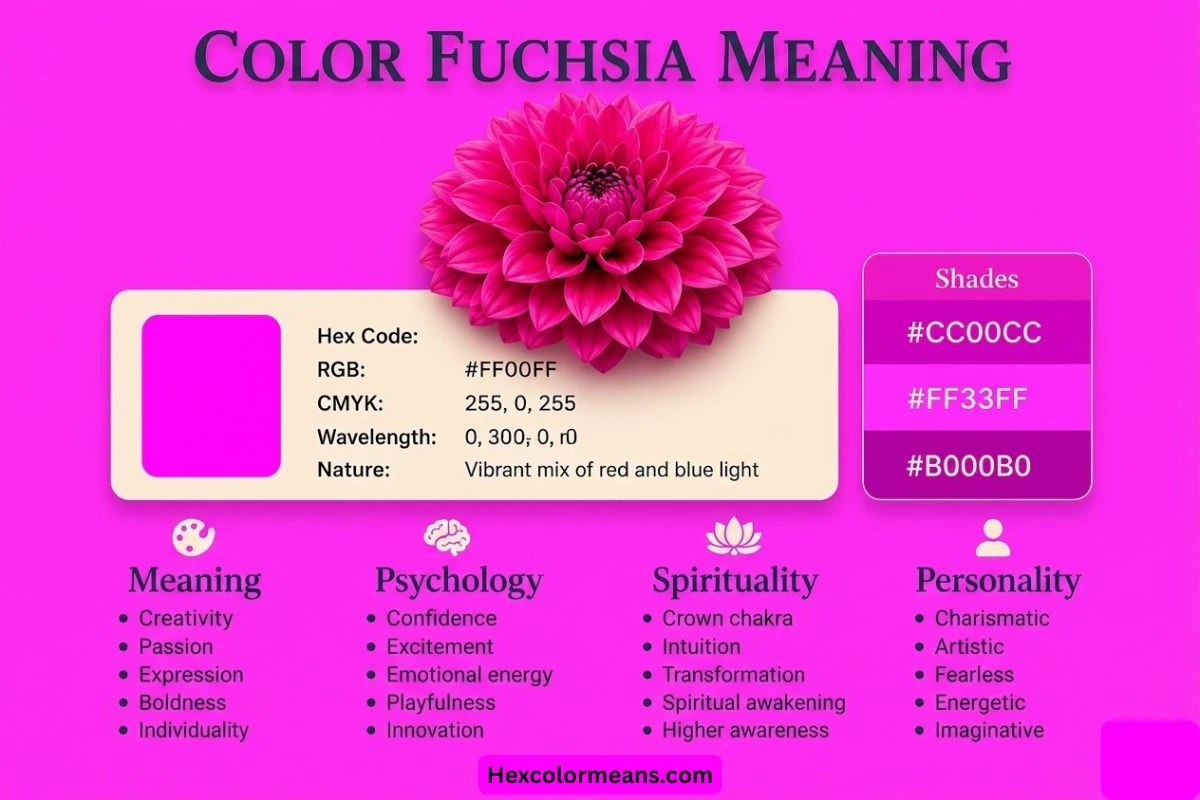
Fuchsia sits boldly between pink and purple on the color wheel. This position means it blends pink’s warmth and playfulness with purple’s depth and mystery. That combination gives fuchsia a remarkable character. It feels daring but also emotionally rich. It appears feminine yet powerfully assertive.
Picture tropical flowers in full bloom. Imagine fashion runways in Milan and Paris. Think of neon signs in a vibrant city at night. Many high-energy creative brands also choose this color. These things share one quality. They refuse to be ignored. Fuchsia never fades into the background.
In color psychology, fuchsia is called the shade of confidence and creative rebellion. It also means passion and emotional fearlessness. This color does not ask for permission. It steps forward with intensity. It also encourages others to do the same.
Fuchsia does not whisper. It speaks loudly, clearly, and with complete intention.
Key Takeaways
- Fuchsia stands for boldness, passion, creative confidence, and emotional liberation.
- Mentally, fuchsia stimulates energy, assertiveness, and uninhibited self-expression.
- Spiritually, fuchsia connects to the heart chakra and the crown chakra simultaneously, bridging love with higher awareness.
- For brands, fuchsia signals vibrancy, innovation, and unapologetic individuality.
- Across cultures, fuchsia often symbolizes feminine power, celebration, and transformative energy.
What Is the Color Fuchsia?
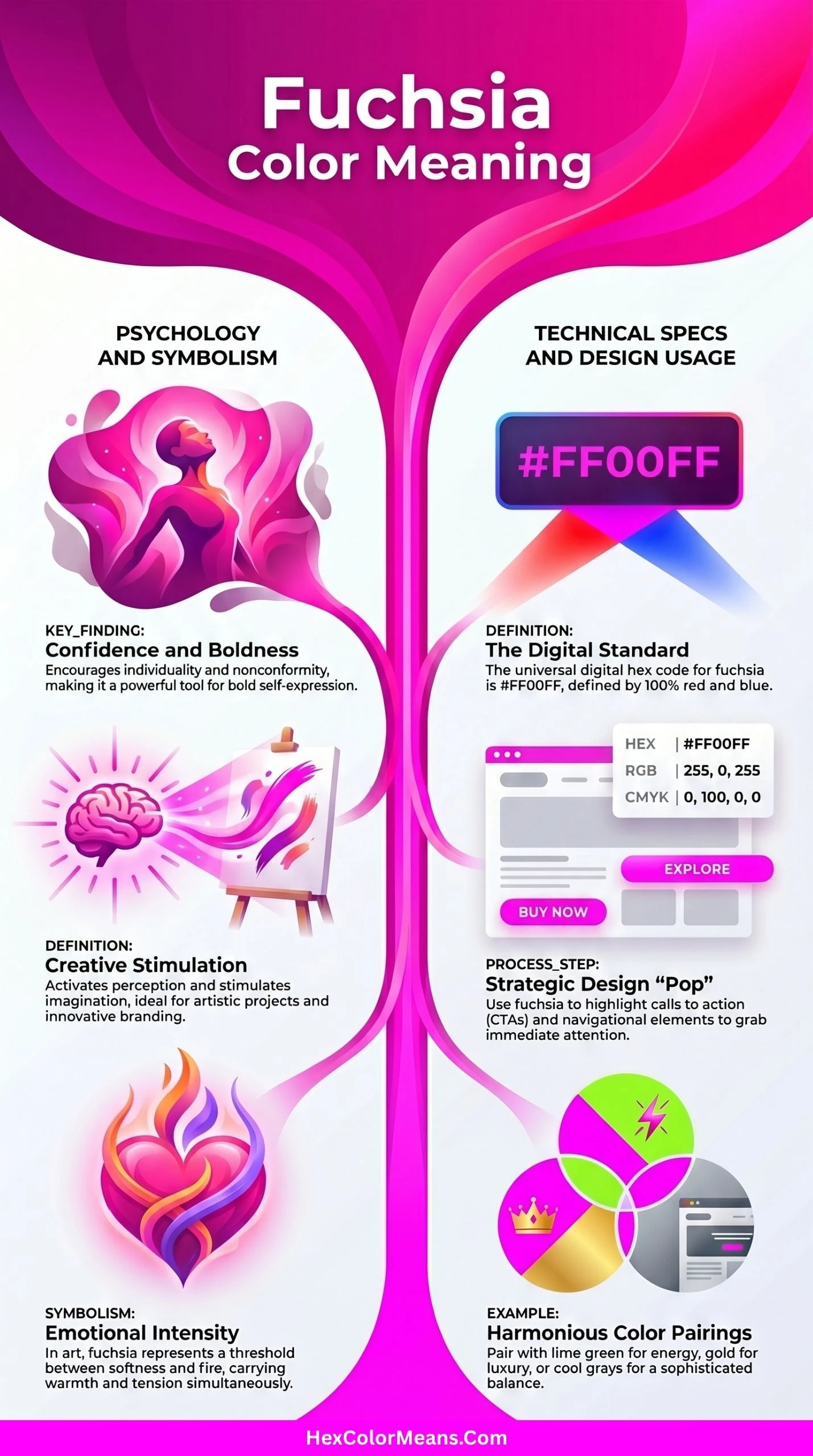
Fuchsia is a vivid, saturated color that blends magenta and purple. It is often confused with hot pink, but it contains more blue and reads with a distinctly purplish undertone. The name comes from the fuchsia plant, a flowering shrub named after the 16th-century German botanist Leonhart Fuchs.
Common digital codes for true fuchsia are listed here.
- HEX: #FF00FF
- RGB: 255, 0, 255
- HSL: Hue: 300 degrees, Saturation: 100%, Lightness: 50%
- CMYK: 0, 100, 0, 0
Visually, fuchsia is one of the most saturated colors the human eye can process. It does not exist as a single wavelength of light. Instead, it is perceived by the brain when both red and blue light receptors are stimulated simultaneously without any green activation. This makes fuchsia what scientists call an extra-spectral color. The brain creates it, rather than light naturally producing it. This is part of what gives fuchsia its electric, almost surreal visual intensity.
The color fuchsia is not a monolith. It spans a range of emotional expressions depending on shade and tone. Its most popular variations include:
- Hot Pink: A slightly warmer, redder version of fuchsia associated with playfulness, confidence, and pop culture energy.
- Magenta: A cooler, more balanced version linked to creativity, compassion, and emotional harmony.
- Rose Fuchsia: A softer, more feminine variation connected to romance, tenderness, and emotional openness.
- Deep Fuchsia: A darker, richer take that feels mysterious, intense, and artistically sophisticated.
- Neon Fuchsia: The most electric variation, associated with nightlife, rebellion, and high-energy self-expression.
What Colors Go With Fuchsia
Pairing fuchsia with the right colors creates compositions that feel electric and bold. Because fuchsia carries such intense energy, the colors around it can either amplify its volume or provide necessary breathing room.
Black: Creates a iconic, high-drama pairing that feels sharp and rebellious. Black halts fuchsia’s brightness, making each pop feel deliberate and cool.
Lime green: The ultimate complementary contrast. This pairing vibrates with energy, feeling playful, futuristic, and unapologetically bold. Used frequently in streetwear and Y2K aesthetics.
Teal and deep turquoise: A sophisticated, jewel-toned pairing that feels lush and cinematic. Teal cools down fuchsia’s heat, resulting in a balanced, artistic contrast.
Powder blue and baby blue: Introduces a soft, airy sweetness that tames fuchsia’s intensity. The combination feels whimsical, nostalgic, and unexpectedly gentle.
Silver and chrome: Adds a sleek, metallic futurism. Silver reflects fuchsia’s playfulness without competing for attention, feeling modern and editorial.
Neon yellow: Pure maximalist energy. This pairing is loud, confident, and sporty. It works best in small accents or graphic, color-blocked designs.
Similar Colors to Fuchsia
If you are looking for colors similar to fuchsia, consider these alternatives.
Hot Pink (Hex: #FF69B4): A slightly warmer, more wearable pink with less purple undertone. Hot pink feels more playful and less intense than fuchsia’s electric edge.
Magenta (Hex: #FF00FF): A true primary subtractive color (CMYK’s M). Magenta is equally vibrant but leans more violet-red than fuchsia’s balanced purple-pink.
Hollywood Cerise (Hex: #F400A1): A slightly deeper, warmer version of fuchsia. It shares the same artificial brightness but feels more “red-pink” than “purple-pink.”
Raspberry (Hex: #E30B5C): A darker, more berry-toned pink with visible red depth. Raspberry feels juicier and more organic while retaining fuchsia’s boldness.
Purple Pizzazz (Hex: #FE4EDA): A near-identical match with just a touch more blue. It carries fuchsia’s energy but feels slightly more celestial and cool-toned.
History and Interesting Facts
History of the Color Fuchsia
Fuchsia has a history rooted in science and discovery. The color was first synthesized in 1859 by French chemist Francois-Emmanuel Verguin. He created a synthetic dye from coal tar and named it fuchsine, later also called magenta, after the Battle of Magenta fought that same year in northern Italy.
Before this synthetic breakthrough, achieving such an intense pink-purple hue in textiles required complex natural processes. The synthetic version revolutionized the textile industry. For the first time, garments could be dyed in this vivid, almost unnatural shade at a fraction of the previous cost.
Throughout the late 19th century, fuchsia fabric flooded European fashion markets. It was so popular it briefly became a symbol of modernity and scientific progress. The rise of synthetic dyes, and fuchsia specifically, transformed not just fashion but the chemical industry as a whole.
In the 20th century, fuchsia became deeply embedded in pop culture. It defined entire aesthetic movements. The punk era of the 1970s claimed it as a color of rebellion. The 1980s adopted it as a symbol of excess and extravagance. The 1990s saw it in rave culture, sportswear, and neon graphic design. Today, fuchsia continues to evolve. It appears in digital design, luxury fashion, and social media aesthetics with undiminished force.
Interesting Facts About the Color Fuchsia
Here are notable facts about fuchsia worth knowing.
- Fuchsia does not exist as a wavelength of light. The brain constructs it by combining red and blue signals, making it neurologically unique among colors.
- The first synthetic fuchsia dye helped launch the modern chemical industry. Its discovery by Verguin in 1859 triggered a wave of synthetic color research.
- In web and screen design, fuchsia and magenta share the exact same hex code:
#FF00FF. The two names are used interchangeably in CSS standards. - Fuchsia is the national color of El Salvador, appearing prominently in the country’s cultural ceremonies and traditional dress.
- Research in color psychology indicates fuchsia is one of the fastest colors the human eye detects in a cluttered visual field. It commands attention almost instantly.
- The fuchsia plant, from which the color takes its name, is native to Central and South America. Its drooping flowers come in magenta and purple and bloom year-round in warm climates.
- Fuchsia was used heavily during the suffragette movement in the early 20th century. Women wore it alongside green and white to signal their political identity and boldness.
Symbolism and Representation
Fuchsia is a color of unashamed vitality. It holds a deep connection to self-expression and emotional honesty. This color also signifies a refusal to conform.
It often represents several key ideas. The first is passionate confidence, as fuchsia does not soften itself for comfort. Next, it symbolizes creative rebellion. Artistic vision and social nonconformity are commonly linked with this hue. It also relates to emotional boldness. Finally, it connects to the celebration of femininity in all its complex forms.
Unlike red, fuchsia does not carry aggression or danger. Also, unlike pink, it does not rely on softness or sweetness. Instead, it occupies a powerful and unapologetic space of its own. Fuchsia invites people to show up fully and without apology. It pushes toward self-celebration rather than self-restriction. This color encourages the boldest version of personal identity to step forward.
Meaning of the Fuchsia Color in Spirituality
In spirituality, fuchsia occupies a fascinating dual position. It resonates with both the heart chakra and the crown chakra simultaneously. This is unusual among colors, which typically connect to one primary energy center.
The heart chakra, located at the center of the chest, governs love, compassion, and emotional connection. The crown chakra, at the top of the head, manages higher consciousness and spiritual awareness. Fuchsia bridges both. It brings love into contact with divine insight. This dual resonance makes it a color of integrated spiritual living, where emotional experience is not separate from higher wisdom.
A balanced fuchsia energy in spiritual practice brings feelings of self-love combined with universal love. It fosters a sense of spiritual joy, which differs from ordinary happiness. Spiritual joy is a deep, steady celebration of existence itself. However, an imbalance can tip into emotional overwhelm or spiritual grandiosity. Grounding practices become especially important when working with fuchsia energy.
Fuchsia is used in various spiritual contexts for its activating properties. It appears in sacred ceremonies designed to awaken joy and release grief. Energy healers use it to stimulate emotional clearing and open the heart to receive. Some practitioners wear fuchsia to ceremonies as a way to embody both love and power simultaneously. It appears in crystal healing through stones like rubellite and pink tourmaline, which carry similar vibrational qualities.
Psychological Meaning of Color Fuchsia
Psychologically, fuchsia is one of the most stimulating colors available. It does not promote rest or quiet contemplation. Instead, it activates. It energizes. It pushes toward action and expression.
Fuchsia strongly supports emotional honesty. It reduces the tendency to suppress feelings. Exposure to this color encourages people to say what they feel rather than manage or conceal it. It also heightens social confidence. People who wear fuchsia are often perceived as more outgoing and assertive, regardless of their baseline personality.
Creatively, fuchsia pushes toward bold, unconventional thinking. It disrupts the habit of playing it safe. It encourages choices that prioritize originality over acceptability. This makes it especially valuable for creative professionals who want to break out of predictable patterns.
That said, excessive fuchsia exposure presents specific challenges. It can amplify emotional sensitivity to the point of reactivity. It may trigger restlessness or impatience in environments that require stillness. Likewise, it can also contribute to a sense of social pressure to perform or present confidently, which exhausts introverted personalities over time.
For these reasons, using fuchsia intentionally and in balanced doses yields the best results.
Color Fuchsia Personality Traits
Positive Traits
People attracted to fuchsia frequently exhibit remarkable positive qualities. They possess a fierce and unfiltered creativity. Their emotional expression is typically bold and authentic. These individuals demonstrate a consistent willingness to stand out from the crowd. Their thinking is original, future-facing, and genuinely innovative. A deep love for beauty, performance, and artistic risk-taking defines them. Their interests often include fashion, visual art, music, dance, and any form of expressive culture.
Negative Traits
People with fuchsia-linked traits also face specific challenges. They can struggle with impulsivity in decision-making. Their emotional intensity sometimes creates friction in relationships that value restraint. A tendency toward attention-seeking behavior is commonly observed. They may also find it difficult to accept criticism without defensiveness. Periods of burnout can follow extended phases of high-energy expression. Their need for stimulation and novelty can make long-term commitments feel restrictive.
What Does the Bible Say About Color Fuchsia?
The Bible does not explicitly mention fuchsia by name, as the color was only named in the 19th century. However, biblical references to vivid crimson, scarlet, and rose-tinted hues share thematic overlap with what we now call fuchsia.
In Proverbs 31:22, the virtuous woman is described as being clothed in fine linen and purple. This passage indicates that brilliant, bold colors worn by women of strength were seen as signs of dignity and honor rather than vanity. The vivid nature of such garments symbolized both capability and worth.
Isaiah 1:18 uses the image of crimson and scarlet to discuss transformation. “Though your sins are like scarlet, they shall be as white as snow.” This passage ties vivid, saturated color to the concept of emotional and spiritual starting points, places from which profound change becomes possible. Fuchsia, as a color defined by its vibrancy and emotional intensity, aligns with this theme of transformation through boldness rather than passivity.
In Revelation 18:12, scarlet fabrics are listed among treasures lost when Babylon falls. This signals that brilliant, deeply saturated colors were considered among the most precious of human creations, tied to beauty, luxury, and the fullness of human experience.
Cultural and Religious Significance of the Fuchsia Color
1. Latin American Culture
In many Latin American cultures, fuchsia holds a place of festive joy and communal celebration. It appears prominently in traditional textiles from Mexico, Guatemala, and Peru. Weavers use it in huipiles, rebozos, and ceremonial blankets to signal vitality and community belonging. The color is not considered excessive or loud in these traditions. It is considered alive. Wearing fuchsia in festive contexts signals a willingness to participate fully in life.
2. South Asian Culture
Across India, Pakistan, and Bangladesh, fuchsia appears constantly in wedding ceremonies and religious festivals. It is a color of auspicious celebration. Brides in certain regional traditions wear fuchsia-toned lehengas and saris. The color signals joy, fertility, and the richness of new beginnings. During festivals like Holi and Diwali, fuchsia appears in decorations, clothing, and offerings as a marker of abundance.
3. African Symbolism
In various African cultures, fuchsia tones appear in ceremonial dress and woven textiles used during rites of passage. The boldness of the color communicates courage and communal pride. Particularly in West African fabric traditions, bright magenta and fuchsia tones signal status transitions, including movement from youth into adulthood or from grief into renewal.
4. Japanese Culture
In Japanese aesthetics, fuchsia is linked to ume blossoms and early spring. It represents endurance and the courage to bloom in difficult conditions. Traditional woodblock prints often feature fuchsia-pink hues in floral scenes that communicate both fragility and resilience. In modern Japan, fuchsia appears frequently in kawaii culture, where it functions as a symbol of playful, unapologetic self-expression.
5. Western Pop Culture
In Western society, fuchsia became a defining color of several major cultural movements across the 20th century. It was central to the aesthetic of punk, glam rock, and new wave music. It defined the visual excess of 1980s fashion. Similarly, it powered the neon energy of rave culture in the 1990s. Today, it functions as a key color in digital aesthetics, social media branding, and the broader conversation around feminism and female empowerment. Its continued presence signals its refusal to become dated.
6. LGBTQ+ Culture
Fuchsia carries deep significance within LGBTQ+ communities. Its proximity to the pink that historically marked gay men in the pink triangle, combined with its vibrancy and refusal to conform to muted norms, has made it a color of pride, visibility, and joyful resistance. It appears frequently in Pride parades, artwork, and community spaces as a color that celebrates identities that have long been told to dim their light.
7. Fashion and High Design
In the world of fashion, fuchsia is one of the most recurring statement colors across decades. Designers from Elsa Schiaparelli, who famously championed shocking pink, to contemporary designers like Valentino with his iconic pink collections, have used fuchsia to push against conventionality. It is the color that fashion reaches for when it wants to make an unmistakable declaration.
Dream Interpretations of Color Fuchsia
Fuchsia in dreams connects to urgent emotional energy. This energy is often positive. It can be transformative as well. Common meanings are organized below.
Bright fuchsia signals an emotional awakening. Suppressed feelings are demanding attention and expression. Deep fuchsia points to hidden passion or desire. Something important has not yet been allowed to surface.
Fuchsia clothing suggests a desire to be seen and acknowledged. The dreamer may be seeking recognition in waking life. Fuchsia light functions as a symbol of creative inspiration arriving suddenly.
Fuchsia flowers indicate the blossoming of self-confidence. Something long dormant is finally ready to grow. Such dreams frequently arrive at pivotal moments. Major life choices or identity shifts tend to prompt these visions.
How to Use the Color Fuchsia
This color adds intensity without aggression. It feels bold but not threatening. The following details show its practical uses across many contexts.
1. Color Fuchsia in Business
Fuchsia makes a powerful statement in business environments. It signals creative leadership rather than conventional authority. It communicates that the organization values originality and courage over tradition and caution.
This color suits certain types of businesses particularly well. Beauty brands use it to convey confidence and vibrancy. Entertainment companies select it for its high energy and visibility. Youth-focused brands choose fuchsia because it speaks directly to a generation that prizes authenticity. Fashion labels use it to communicate boldness and forward-thinking aesthetics. A business environment that incorporates fuchsia reads as dynamic and innovative. It tells clients and employees alike that conventional approaches are not the default.
2. Color Fuchsia in Branding and Marketing
Fuchsia establishes instant visual recognition. Few colors cut through digital and physical noise as efficiently. It communicates a brand that is self-assured, creative, and unafraid of attention.
Several famous brands use fuchsia with great success. Barbie’s branding has long relied on this color as its primary visual identity, and the 2023 film reignited its cultural power to global effect. T-Mobile uses fuchsia as its dominant brand color, making it one of the most recognizable telecoms in the world. Cosmetics brands like NYX and Benefit use it to signal playfulness and creative boldness. In digital contexts, fuchsia-dominant design immediately communicates a refusal to play it safe. This draws audiences who see themselves as equally bold.
3. Color Fuchsia in Interior Design
In interior design, fuchsia reshapes a room’s emotional atmosphere immediately. It is not a color to use casually. It requires intention. But when used well, it creates some of the most visually striking interiors possible.
Fuchsia works best as an accent rather than a dominant wall color in most residential settings. A single fuchsia sofa or armchair in a neutral room creates a focal point that is both artistic and energizing. In creative studios, a fuchsia wall behind a workspace stimulates originality and breaks mental stagnation. Paired with white, fuchsia feels fresh and modern. Combined with deep navy or charcoal, it becomes sophisticated and dramatic. Gold accents with fuchsia evoke a sense of luxury and confidence. For those bold enough to commit fully, an all-fuchsia room creates a maximalist statement that prioritizes experience over restraint.
4. Fuchsia Color in Cinema
Filmmakers use fuchsia deliberately to signal heightened emotional or psychological states. It appears in scenes where ordinary reality is being disrupted or transcended. The color communicates excess, passion, and the crossing of boundaries.
It appears in certain genres with particular frequency. Romantic comedies use fuchsia to signal peak emotional moments. Musical films rely on it for high-energy, joyful sequences. Fantasy and surreal films use it to mark spaces or characters that exist outside normal rules. Psychological thrillers sometimes use fuchsia to suggest a character’s breaking point. Directors like Pedro Almodovar have built entire visual languages around fuchsia and related magentas, using the color to represent female strength, emotional complexity, and social transgression.
5. Fuchsia Color in Humans
Fuchsia reflects specific qualities in those who choose to wear it. It indicates emotional courage and a willingness to be seen fully. Wearers communicate that they are not interested in blending in.
The color shows creative independence. People who reach for fuchsia regularly tend to see personal style as a form of artistic practice rather than social compliance. It also signals social confidence. Even in people who describe themselves as introverted, wearing fuchsia often reflects an internal boldness that finds its outlet through aesthetic choices. Their style is expressive by nature. It communicates a strong and defined sense of self.
6. Fuchsia Color in Makeup
Fuchsia makeup is one of the most transformative tools in any beauty kit. It does not merely decorate. It redefines. A single fuchsia lip color shifts the entire emotional register of a face from understated to commanding.
For the eyes, fuchsia eyeshadow creates dramatic contrast against both warm and cool skin tones. It intensifies the appearance of green and brown eyes particularly, as the cool pink-purple tones highlight the warmth of those irises by contrast. A deep fuchsia smoked across the lid and blended into a soft crease creates a look that is equally appropriate for editorial photography and evening occasions. Lighter fuchsia tones applied to the inner corner or beneath the brow bone create a fresh, unexpected brightness. Fuchsia blush applied high on the cheekbones brings a vivid flush that photographs exceptionally well under both natural and artificial light. It creates the effect of health, warmth, and vitality simultaneously. A fuchsia lip requires almost nothing else. The color is complete in itself. Worn with a bare face, it reads as confident. Paired with winged liner and sculpted brows, it becomes powerful.
For a fully coordinated fuchsia makeup look, consider pairing a fuchsia lip with a warm nude eye and flushed fuchsia blush. The result is cohesive, modern, and confident without being overwhelming.
7. Fuchsia Food
Naturally fuchsia-colored foods are rare, which makes them visually striking and nutritionally significant. Their vivid pigment comes from betalains and anthocyanins, two distinct groups of powerful plant compounds.
Betalains, found in beets, are potent anti-inflammatory agents. They also support liver function and cardiovascular health. Anthocyanins, found in dragon fruit and red cabbage, are antioxidants that protect cells from oxidative stress and support brain health over time. Dragon fruit with its brilliant fuchsia flesh and black seeds is one of the most visually arresting foods in existence. It contains vitamin C, fiber, and prebiotics that support gut health. Red beet juice delivers nitrates that improve blood flow and athletic performance. Hibiscus flowers, often brewed into a deep fuchsia tea, are rich in vitamin C and have been shown to support healthy blood pressure. Radishes with their sharp magenta skin offer digestive support and anti-inflammatory compounds. Pomegranate arils, deep fuchsia in color, are linked to improved memory and heart health through their high concentration of polyphenols. Including these foods creates both visual beauty on the plate and meaningful nutritional benefit in the body.
8. Fuchsia Color in Quotes and Idioms
The English language does not have a long history of fuchsia-specific idioms, as the word entered common use only in the mid-19th century. However, the broader color family it belongs to appears in several culturally significant expressions.
The phrase “tickled pink” describes a feeling of extreme pleasure or delight, with fuchsia as a natural intensification of that same emotional register. “Seeing the world through rose-colored glasses” speaks to optimism and a tendency to perceive life as more positive than it may objectively be. Fuchsia, as a deeper and more saturated version of rose, might be said to represent a more electrified version of this same disposition. The phrase “in the pink” means in excellent health or high spirits. These expressions collectively link the fuchsia family of colors to emotional aliveness, heightened experience, and an orientation toward joy.
9. Fuchsia Color in Art and Architecture
Artists select fuchsia when they want to convey emotional urgency or push against conventions of restraint. Its intensity makes it impossible to use casually. Every application reads as a deliberate statement.
In painting, fuchsia functions as one of the most powerful accent colors available. It commands the eye instantly and forces the viewer to engage. Abstract expressionists used magenta and fuchsia tones to convey emotional overwhelm and passionate intensity. Pop artists like Andy Warhol incorporated fuchsia-adjacent tones into their work to reference commercial culture and the vibrancy of modern American life. In architecture, fuchsia appears primarily in public art, murals, and feature walls rather than structural elements. Mexican modernist architect Luis Barragan famously used intense pink and fuchsia tones in his buildings, combining them with terracotta and ochre to create spaces of extraordinary emotional power. The Barbie Dreamhouse as a cultural artifact has brought fuchsia architecture into contemporary conversations about design, identity, and the power of color to shape experience. In contemporary public art, fuchsia murals in urban spaces communicate community vibrancy, creative possibility, and a refusal to accept the gray anonymity of institutional design.
10. Songs With Fuchsia in the Title
Music does not have a deep catalog of songs explicitly titled around fuchsia, but the color’s emotional register appears across countless songs in spirit. The boldness, passion, and intensity that fuchsia represents live in music that refuses to be quiet.
Shades of pink and magenta appear in song titles like “Pink” by Aerosmith, which celebrates uninhibited expression. “Shocking Blue” by the band of the same name carries that fuchsia-adjacent energy of vivid, electric feeling. Artists like Nicki Minaj, who has built part of her visual identity around fuchsia and hot pink, use the color’s energy in their sound even when not naming it directly. The aesthetic DNA of fuchsia lives in music that is loud, emotionally unguarded, and proud of its own excess. It is the color of music that does not apologize for how much it wants to feel.
11. Cities and Places With Fuchsia Energy
While no major city carries fuchsia in its official name, certain places have absorbed its spirit completely. Jaipur, India, known as the Pink City, comes closest to fuchsia in its architectural palette. Its old city walls and buildings are painted in deep rose and magenta tones that intensify toward fuchsia at certain times of day under strong light.
Guanajuato in Mexico features buildings painted in brilliant saturated hues including fuchsia and magenta, creating a streetscape that feels like walking through a living painting. San Francisco’s Castro district carries fuchsia energy through its rainbow murals, vibrant storefronts, and community aesthetic of bold self-expression. Miami’s Art Deco district uses fuchsia neon and pastel tones to create one of the most electrically colorful urban environments in North America. These places do not merely contain the color. They embody its values: boldness, creativity, celebration, and an absolute commitment to being seen.
12. The Color Fuchsia in the Garden
Incorporating fuchsia into a garden creates an immediate sense of drama and vitality. Few color choices have the same power to transform an outdoor space from pleasant to unforgettable. Fuchsia blooms do not allow the eye to rest. They pull focus and anchor entire planting schemes around themselves.
The fuchsia plant itself is one of the most architecturally interesting garden subjects available. Its pendant blooms, which drop in double-skirted layers of magenta and purple, create movement and lightness simultaneously. They attract hummingbirds and pollinators with unusual intensity. Bougainvillea in its deepest fuchsia varieties creates cascading walls of vivid color that transform walls, trellises, and fences into living tapestries. Rhododendrons in fuchsia tones bring large-scale drama to spring gardens. Dianthus and petunias in fuchsia shades fill containers and borders with high-season vibrancy. Garden salvia in magenta-fuchsia provides long-lasting color that supports wildlife throughout summer and autumn.
Common fuchsia garden plants to consider include the classic fuchsia for hanging baskets and shade gardens, bougainvillea for climbing structures in warm climates, and rhododendron for large-scale spring impact. Dianthus brings compact, fragrant color to borders, while petunia offers reliable container color from spring through autumn. Together, these plants craft a garden that feels audaciously alive. They create a space that does not apologize for its own beauty.
A Final Note
Fuchsia operates on a level beyond mere decoration. It is a color of psychological activation and spiritual integration. Its core meanings connect to passionate self-expression, emotional honesty, and the courage to occupy space without apology.
Fuchsia asks nothing from the observer except full engagement. It does not reward passive viewing. It demands that you feel something. Historically, its emergence from a scientific discovery in the 19th century made it a color of modernity and progress. Today, it retains that link to the new and the possible. Now it represents creative leadership, cultural pride, and the power of living life in full color.
Applied with intention, fuchsia functions as a tool of transformation. It changes not only how spaces look but how people feel within them. It lifts ordinary environments toward something more alive, more honest, and more fully human. When you choose fuchsia, you are choosing a color that has never once pretended to be something smaller than it is. That is perhaps its greatest lesson for anyone willing to pay attention.